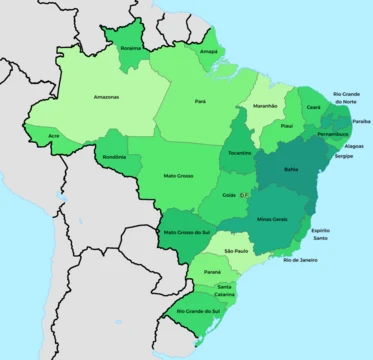
Bahia
Brazilian state, former colonial capital, center of sugar and slavery.

Bahia is one of the 26 states of Brazil, located in the Northeast Region. It is the fourth-largest Brazilian state by population and the fifth-largest by area. Bahia was a center of sugarcane cultivation from the 16th to the 18th centuries and was integral to the slave trade, with more than a third of all slaves taken from Africa sent to Brazil, mostly processed in Bahia.
- Capital
- Salvador
- Area
- 5th-largest among Brazilian states
- GDP share
- 4.2% of Brazil's GDP
Lore & Background
In 1549, Portugal established Salvador on a hill facing the Bay of All Saints. The captaincy was the first to fail, with its lands reverting to the Portuguese crown in 1549. During the union of Portugal and Spain, the Dutch West India companies attempted to conquer Bahia but were unsuccessful. The state contains historic towns such as Cachoeira from the sugar era.
Reader's Guide
Bahia's significance lies in its historical role as the first capital of Portuguese America and a key hub of the Atlantic slave trade and sugar economy. Its politics have been closely intertwined with national politics, producing figures such as Ruy Barbosa and Antônio Carlos Magalhães, whose influence shaped state politics for decades. The state's geography includes the Bay of All Saints, the largest bay on the Brazilian coast, and the São Francisco River, vital for irrigation and hydroelectric power. Bahia's climate is tropical, with 68% of its territory in the semi-arid zone. Today, it is a predominantly working-class industrial and agricultural state, home to 7% of Brazil's population and producing 4.2% of its GDP.
Did You Know?
- Bahia's capital Salvador was originally named 'Cidade do São Salvador da Bahia de Todos os Santos'.
- The Sobradinho Dam on the São Francisco River created one of the largest reservoirs in the world.
More in Brazilian States 25-33
Elsewhere in the Brazilian States universe
Spotted an error? Know more?
This is a living reference — every entry is fact-audited, and reader corrections feed straight into our audit queue. Suggest an edit · See this site's audit record