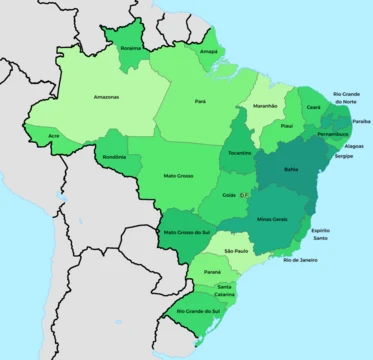
Santa Catarina (state)
Brazilian state with the lowest homicide and illiteracy rates.

Santa Catarina is one of the 27 federative units of Brazil, located in the centre of the country's Southern region. The state is noted for its mountainous terrain, high socioeconomic indicators, and diverse immigrant heritage.
Lore & Background
Santa Catarina was originally inhabited by the Carijós people of the Tupi-Guarani group. The state later became a destination for Italian, German, and other European immigrants, as well as African slaves and their descendants.
Reader's Guide
Santa Catarina holds the best socioeconomic indicators in Brazil, leading in life expectancy and public safety, with the lowest rates of homicide, illiteracy, poverty, and extreme poverty. It has the third-highest Human Development Index (HDI), third-highest GDP per capita, and third-lowest infant mortality, and is the federative unit with the least economic inequality. The state's name derives from the island of Santa Catarina, named either by Francisco Dias Velho, who built a chapel to Catherine of Alexandria, or by Sebastian Cabot, who may have dedicated it to Saint Catherine or his wife.
Did You Know?
- Santa Catarina is one of only two Brazilian states whose capital (Florianópolis) is not the largest city; the other is Espírito Santo.
- The state's area is comparable to that of Hungary.
- The name 'Catherine' has a debated origin; the traditional association with the Greek word 'katharos' (pure) is considered a folk etymology.
Geography and Climate
Its borders are defined by Paraná to the north, Rio Grande do Sul to the south, the Atlantic Ocean to the east, and Argentina's Misiones province to the west. Climate varies with elevation: the coastal lowlands and lower plateau zones experience a humid subtropical pattern (Cfa under the Köppen-Geiger system), while the higher plateau areas shift to an oceanic climate (Cfb).
Colonial Origins and the Founding of the State
The lands that would become Santa Catarina were home to the Carijós, a Tupi-Guarani indigenous group, before European contact. Early Portuguese and Spanish expeditions probed the coast in the 16th century, yet no permanent settlements took root during that century. The state was deliberately established to push Portuguese dominion southward toward the Rio de la Plata.
Socioeconomic Standing
Santa Catarina consistently ranks at the top of Brazil's national indicators. It leads the country in life expectancy and public safety, while simultaneously posting the lowest rates of homicide, illiteracy, poverty, and extreme poverty among all federative units. The state holds the third-highest Human Development Index, the third-highest GDP per capita, and the third-lowest infant mortality rate. Perhaps most strikingly, it is the Brazilian state with the least economic inequality. These figures place it in an elite tier alongside a handful of peers.
Naming, Identity, and Cultural Mosaic
The state's population was shaped by successive waves: indigenous Carijós, Azorean and Portuguese immigrants, Italian and German settlers, and African slaves and their descendants, all contributing layers to a distinctly southern Brazilian identity.
Frequently Asked Questions
Who is Santa Catarina (state)?
Santa Catarina is one of Brazil's 27 federative units, situated in the heart of the country's Southern region. It is recognized for its rugged, mountainous landscape and a rich tapestry of immigrant communities that shaped its culture.
What makes Santa Catarina (state) stand out among Brazilian states?
It consistently records the lowest homicide and illiteracy rates in the country, alongside notably high socioeconomic indicators. Its mountainous geography and diverse heritage of German, Italian, Polish, and other immigrant groups further distinguish it.
Where is Santa Catarina (state) located?
It sits in the central part of Brazil's Southern region, bordered by the Atlantic coastline to the east and flanked by other southern states to the north and west. The terrain is heavily mountainous, with the Serra do Mar running along much of its interior.
More in Brazilian States 25-33
Elsewhere in the Brazilian States universe
Spotted an error? Know more?
This is a living reference — every entry is fact-audited, and reader corrections feed straight into our audit queue. Suggest an edit · See this site's audit record