Espírito Santo
A southeastern Brazilian state with coastal ports and diverse habitats.

via Wikipedia: Espírito Santo · see source
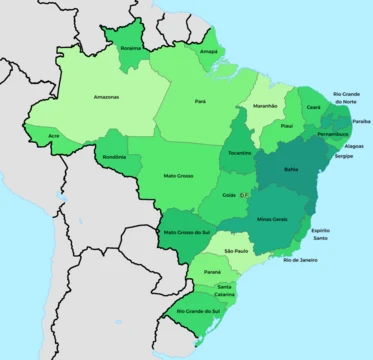
Espírito Santo is a state in southeastern Brazil, with its capital at Vitória and its largest city at Serra. It has an extensive coastline hosting some of the country's main ports, and its beaches are significant tourist attractions. The state is divided into 78 municipalities. The capital, Vitória, is located on an island, bordering the municipalities of Vila Velha, Cariacica, and Serra. These municipalities, plus the outer cities of Fundão and Guarapari, constitute the state's main metro area. In the northern extremes is Itaúnas, in the municipality of Conceição da Barra, a tourist location known for its sand dunes and forró tradition.
- Largest city
- Serra
Verified Timeline
Lore & Background
Espírito Santo was first inhabited by Amerindians, whose different tribes were usually semi-nomadic, but precolonial Brazil has no recorded history. The area was colonized by the Portuguese starting in the 16th century. The Captaincy of Espírito Santo, a hereditary fief, was granted to Vasco Coutinho by Manuel I of Portugal around three decades after the Portuguese first landed in Brazil in 1500. Coutinho arrived on 23 May 1535, bringing a retinue of 60 soldiers, colonists, slaves, and servants, settling on Vitória Island and around the Bay of Vitória. The capital was at first established in Vila Velha, but due to frequent raids by Amerindians, it was moved to the current capital of Vitória, founded on 8 September 1551, on an island near Vila Velha, later named Vitória Island. In 1556, after the arrival of European missionaries, the cities Serra, Nova Almeida, and Santa Cruz were founded. The captaincy remained under the influence of Coutinho's family for 140 years. It was elevated to province status in 1821, following the 1815 elevation of Brazil to a constituent kingdom of the United Kingdom of Portugal, Brazil, and the Algarves, prompted by the 1808 transfer of the Portuguese court to Brazil fleeing the Napoleonic Invasion of Portugal. After the Independence of Brazil in 1822, Espírito Santo's provincial status was kept. Emperor Pedro II visited in 1860 during one of his tours of Brazil. In 1889, with the advent of the First Brazilian Republic, Espírito Santo was made one of the states of Brazil. Afonso Cláudio de Freitas Rosa was appointed the first governor by the provisional government. The first elected governor, Alfeu Adolfo Monjardim de Andrade e Almeida, was inaugurated on 7 June 1891.
Reader's Guide
Espírito Santo's significance lies in its colonial history as a hereditary captaincy and its evolution into a Brazilian state. It was carved out of the Captaincy of Bahia in the 18th century, during colonial rule, and named after a 16th-century captaincy covering roughly the same area of coast. Following the elevation of Brazil to a constituent kingdom in 1815, Espírito Santo was elevated to a province. After Brazil became a republic in 1889, it was granted statehood. Its economy: during the first three centuries of Portuguese colonialism, the main cash crop was sugarcane, until coffee overtook it in the mid-19th century. During the colonial era, periods of gold rush occurred, but not as much gold was found in Espírito Santo as in neighboring São Paulo and Minas Gerais. Another reason for subdued expansion was the colonial administration's prohibition of laying roads into Minas Gerais, as gold could be smuggled through the state. The state's volcanic islands of Trindade and Martim Vaz, 715 kilometers east of Vitória, are part of Espírito Santo. Its culture includes Amerindian groups such as the Tupiniquim, Temininó, Aymoré, Puri, and Botocudo. The unofficial demonym 'capixaba' has disputed origins: it is Tupi for 'corn hair', reportedly because the blond hair of European settlers reminded Amerindian natives of the golden color of corn; a more mainstream explanation is that it is a metaphor for a corn-grower, as Vitória Island was full of corn plantations in early Portuguese rule; a third etymology is from the name of a local tribe. Originally capixaba referred only to people from Vitória, but eventually came to refer to those born anywhere in the state. The official state demonym is 'espírito-santense'. The state's current symbols were adopted in the early 20th century.
Did You Know?
- The name 'Espírito Santo' means 'Holy Spirit' in Portuguese, named after the Christian Holy Ghost.
- The capital Vitória is located on an island, which borders the municipalities of Vila Velha, Cariacica, and Serra.
- The volcanic islands of Trindade and Martim Vaz, 715 kilometers east of Vitória, are part of Espírito Santo.
- The unofficial demonym 'capixaba' is Tupi for 'corn hair', reportedly because the blond hair of European settlers reminded Amerindian natives of the golden color of corn.
- About 60–75% of the population of Espírito Santo has Italian ancestry, making it the state with the highest percentage of Italian descendants in Brazil.
More in Brazilian States 1-24
Related in Brazilian States
Links follow this subject's own source article.
Elsewhere in the Brazilian States universe
Spotted an error? Know more?
This is a living reference — every entry is fact-audited, and reader corrections feed straight into our audit queue. Suggest an edit · See this site's audit record