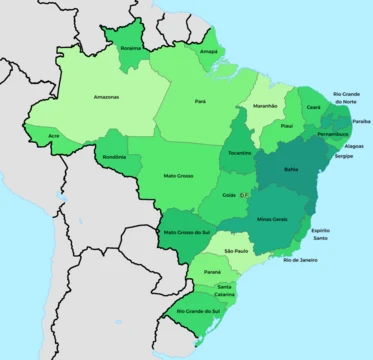
Maranhão
A Brazilian state with a UNESCO capital and rich ecosystems.

Maranhão is a state in Brazil, located in the country's Northeast Region. The state is bordered by the Atlantic Ocean and the states of Piauí, Tocantins, and Pará. Maranhão is known for its distinctive accent among Northeastern Brazilian Portuguese dialects and is featured in literary works such as Exile Song by Gonçalves Dias and Casa de Pensão by Aluísio Azevedo. Its capital, São Luís, is a UNESCO World Heritage Site, and the state contains important environmental preservation areas like the dunes of Lençóis and the Parnaíba River Delta.
- field
- Geography, History, Demographics, Economy
- nationality
- Brazilian
- population
- about 7 million
- capital
- São Luís
- known_for
- UNESCO World Heritage Site capital, Lençóis dunes, babassu palm oil, distinctive accent
Lore & Background
The etymology of Maranhão is uncertain; the name probably originates from Portuguese settlers from Maranhão in Avis, Alentejo. The word was first used to refer to the Marañón River, which today is the Peruvian part of the Amazon system. The area was granted to João de Barros in 1534 as a Portuguese hereditary captaincy. In 1621 Ceará, Maranhão and Pará were united as the 'Estado do Maranhão e Grão-Pará'. In the late 18th century, there was a great influx of enslaved peoples into the region, corresponding to increased cotton cultivation.
Reader's Guide
Maranhão is significant as a state that blends Amazonian, coastal, and Cerrado ecosystems, with the tallest mangrove forests in the world and the stark dune fields of Lençóis Maranhenses National Park. Its capital, São Luís, is a UNESCO World Heritage Site, noted for closely resembling a Portuguese city. Historically, Maranhão was a separate colonial entity and a site of French and Dutch occupation before becoming part of Brazil. The state's economy relies on services, industry, and agriculture, including babassu palm oil, rice, cassava, and exports of aluminium, iron, and soybean. The state's cultural and environmental heritage, including the Parnaíba River Delta and Caju Island, contributes to its importance in Brazilian geography and conservation.
Did You Know?
- The name Maranhão probably originates from Portuguese settlers from Maranhão in Avis, Alentejo, and was first used to refer to the Marañón River.
- The Mearim River has a pororoca (tidal bore) in its lower channel, which greatly interferes with navigation.
A Tapestry of Landscapes and Waterways
Maranhão's terrain shifts dramatically from north to south. The northern half is a low, densely wooded plain threaded by countless rivers, forming the eastern edge of Amazonia's tropical moist forests. In the northwest, the Tocantins–Araguaia–Maranhão forest ecoregion stretches westward into Pará, while the north-central and northeastern zones are defined by the Maranhão Babaçu forests, a palm-dominated ecosystem. The southern half drops into the lower terraces of the great Brazilian Highlands, where Cerrado savannas spread across plateau escarpments such as the Chapada das Mangabeiras, Serra do Tiracambu, and Serra das Alpercatas. Every river in the state flows northward to the Atlantic, and most maintain navigable channels. The Mearim, like the Amazon itself, produces a pororoca—a tidal bore that disrupts navigation in its lower reaches. The western shoreline is deeply indented, sheltered by islands and shoals, and cradles the Baía de Turiassu, Baía de São Marcos, and Baía de São José. Between these bays lies the large island of São Luís. The coast east of Baía de São José gives way to sweeping sand dunes and the restinga forests that colonize stabilized dune fields, culminating in the stark landscape of Lençóis Maranhenses.
A Contested Shoreline: Three Centuries of Imperial Rivalry
The name Maranhão likely traces back to Portuguese settlers from a village in Avis, Alentejo, and was originally applied to what is now the Marañón section of the Amazon River.
Letters, Language, and a Living Heritage City
Maranhão's cultural identity is shaped by a distinctive accent that sets it apart even among the broader Northeastern Brazilian Portuguese dialects. The state has long served as a muse for Brazilian literature; Gonçalves Dias set his Exile Song against its backdrop, and Aluísio Azevedo wove its social textures into Casa de Pensão. At the heart of this cultural life stands São Luís, a capital whose urban fabric most closely mirrors a traditional Portuguese city. By the early twentieth century the city already housed roughly thirty thousand residents alongside several convents, charitable institutes, an episcopal palace, a fine Carmelite church, and an ecclesiastical seminary.
Conservation Frontlines and the Economy of the Palm
Maranhão's natural heritage is protected through several key conservation areas. The dunes of Lençóis, part of the Lençóis Maranhenses National Park, are designated as an important zone of environmental preservation, their stark white fields punctuated by seasonal lagoons. The Parnaíba River Delta, shared with neighboring Piauí, offers a mosaic of lagoons, sand dunes, uninhabited beaches, and small islands. Caju Island within this delta serves as critical habitat for rare bird species. The state's western coastline shelters the Maranhão mangroves, recognized as the tallest mangrove forests on Earth, while restinga forests colonize the stabilized dunes further east. Economically, the Babaçu palm dominates the north-central and northeastern ecoregions and provides oil that is extracted commercially for use in food products and beauty preparations. The state's climate is hot year-round, divided into a wet season of extreme humidity and a drier period, with the south-east trade winds softening coastal temperatures. Population density remains low at about twenty inhabitants per square kilometre, and roughly 68 percent of residents live in urban areas.
More in Brazilian States 1-24
Elsewhere in the Brazilian States universe
Spotted an error? Know more?
This is a living reference — every entry is fact-audited, and reader corrections feed straight into our audit queue. Suggest an edit · See this site's audit record