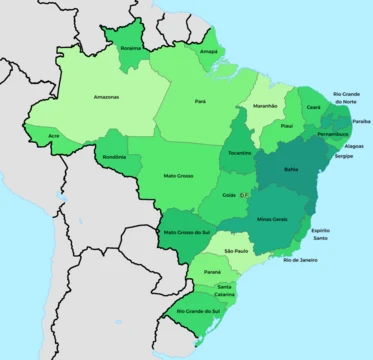
Minas Gerais
Brazilian state known for gold, coffee, and colonial heritage.

via Wikipedia: Minas Gerais · see source
Minas Gerais is one of the 27 federative units of Brazil, being the fourth largest state by area and the second largest in number of inhabitants with a population of 20,539,989 according to the 2022 census. Located in the Southeast Region of the country, its capital and largest city, Belo Horizonte, is a major urban and finance center in Brazil, being the sixth most populous municipality in the country while its metropolitan area ranks as the third largest in Brazil with just over 5.8 million inhabitants, after those of São Paulo and Rio de Janeiro. The state's territory is subdivided into 853 municipalities, the largest number among Brazilian states.
- capital
- Belo Horizonte
- population
- 20,539,989 (2022 census)
- area_rank
- 4th largest among Brazilian states
- population_rank
- 2nd largest among Brazilian states
- gdp_rank
- 3rd largest among Brazilian states
- number_of_municipalities
- 853
- largest_metropolitan_area_rank
- 3rd in Brazil
Lore & Background
Minas Gerais' territory was inhabited by indigenous peoples when the Portuguese arrived in Brazil. It experienced a large migration wave following the discovery of gold in the late 17th century. The mining of gold brought wealth and development to the then captaincy, providing its economic and cultural development; however, gold soon became scarce, causing the emigration of a large part of the population until a new cycle (that of coffee) once again brought Minas Gerais national prominence and whose end led to the relatively late industrialization process. Minas Gerais currently has the third largest GDP among Brazilian states, with a large part of it still being the product of mining activities. The state also has a notable infrastructure, with a large number of hydroelectric plants and the largest road network in the country.
Reader's Guide
Minas Gerais is an important tourist destination due to its natural beauty and historical heritage. It is known for its heritage of colonial architecture and art in historical cities such as Ouro Preto and Diamantina, São João del-Rei, Mariana, Tiradentes, Congonhas, Sabará and Serro. In the south, its tourist points are hydro-mineral spas, such as the municipalities of Caxambu, Lambari, São Lourenço, Poços de Caldas, São Thomé das Letras, Monte Verde (a district of Camanducaia) and the national parks of Caparaó and Canastra. In the Serra do Cipó, Sete Lagoas, Cordisburgo and Lagoa Santa, the caves and waterfalls are the main attractions. The people of Minas Gerais also have a distinctive culture, marked by traditional religious festivals and typical countryside cuisine, in addition to national importance in contemporary artistic productions and also in the sports scene.
Did You Know?
- The state's name may derive from 'Minas dos Matos Gerais' ('Mines of the General Woods'), distinguishing the mining districts from the broader non-mining fields.
- The oldest human fossil found in the Americas, Luzia, was discovered in 1974 in a cave between Lagoa Santa and Pedro Leopoldo, in the Metropolitan Region of Belo Horizonte.
- More than a hundred indigenous groups inhabited the current territory of Minas Gerais at the time of the Portuguese arrival.
- The bandeirante Antônio Rodrigues Arzão discovered the first gold deposits in Minas Gerais territory between 1692 and 1693.
- Minas Gerais has the largest road network in Brazil and a large number of hydroelectric plants.
Geography & Natural Resources
Minas Gerais is bordered by São Paulo in the south and southwest; Mato Grosso do Sul to the west; Goiás and the Federal District to the northwest; Bahia to the north and northeast; Espírito Santo to the east; and Rio de Janeiro to the southeast. The state's terrain is quite rugged and some of Brazil's highest peaks are located in its territory. It is also home to the source of some of Brazil's main rivers, such as the São Francisco, Grande, Paranaíba, Doce and Jequitinhonha rivers, which places it in a strategic position with regard to the country's water resources. It has a tropical climate, which varies from colder and humid in the south to semi-arid in its northern portion. All of these combined factors provide it with a rich fauna and flora distributed in the biomes that cover the state, especially the Cerrado and the threatened Atlantic Forest.
Economic Cycles & Industrial Legacy
The economic story of Minas Gerais is one of dramatic booms and busts driven by extractive industries. Mining began in the 17th century and to this day remains important to the state's economy. The discovery of gold in the late 17th century triggered a large migration wave, bringing wealth and development to the captaincy. Gold soon became scarce, causing emigration until a coffee cycle restored national prominence, followed by relatively late industrialization. Today, Minas Gerais holds the third-largest GDP of any Brazilian state, with mining still contributing a significant share. The state also boasts substantial infrastructure, including a large number of hydroelectric plants and the most extensive road network in the country.
Cultural Heritage & Tourism
Minas Gerais draws visitors for its natural beauty and historical heritage. The state's colonial-era towns—Ouro Preto, Diamantina, São João del-Rei, Mariana, Tiradentes, Congonhas, Sabará, and Serro—preserve remarkable examples of baroque architecture and art. In the south, the appeal shifts toward hydro-mineral spas in Caxambu, Lambari, São Lourenço, Poços de Caldas, São Thomé das Letras, and Monte Verde (a district of Camanducaia), plus the Caparaó and Canastra national parks. In the Serra do Cipó, Sete Lagoas, Cordisburgo and Lagoa Santa, caves and waterfalls are the main attractions. The people of Minas Gerais also have a distinctive culture, marked by traditional religious festivals and typical countryside cuisine, in addition to national importance in contemporary artistic productions and also in the sports scene.
Demographics & Administrative Structure
According to the 2022 census, Minas Gerais is home to 20,539,989 people, making it the second most populous of Brazil's 27 federative units. The state's capital, Belo Horizonte, is a major urban and finance center, ranking as the sixth most populous municipality in the country; its metropolitan area—home to just over 5.8 million residents—sits third in size behind only those of São Paulo and Rio de Janeiro. Administratively, Minas Gerais is divided into 853 municipalities, the highest count of any Brazilian state. The name itself carries historical weight: one interpretation is that it simply means 'General Mines,' referring to a number of mines located in several areas of the region. Another derives it from the former colonial province name 'Minas dos Matos Gerais' ('Mines of the General Woods'), referring to two distinct regions: the region of the mines (Minas), and the 'general' region ('Matos Gerais' or 'Campos Gerais', roughly meaning 'General Fields'), which included areas of sertão far from the mining areas.
More in Brazilian States 1-24
Related in Brazilian States
Links follow this subject's own source article.
Elsewhere in the Brazilian States universe
Spotted an error? Know more?
This is a living reference — every entry is fact-audited, and reader corrections feed straight into our audit queue. Suggest an edit · See this site's audit record