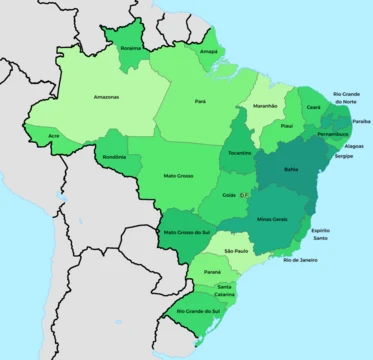
Santa Catarina
A Brazilian state named after Saint Catherine, with a history of Azorean, Italian, German, and other European immigration.

via Wikipedia: Santa Catarina (state) · see source
Santa Catarina is one of the 27 federative units of Brazil, located in the centre of the country's Southern region. It is bordered to the north by the state of Paraná, to the south by Rio Grande do Sul, to the east by the Atlantic Ocean, and to the west by the Argentine province of Misiones. The state covers approximately 95,730.69 square kilometres, ranking as the seventh smallest Brazilian state by area. With a population of 7.6 million in 2022, it is the tenth most populous state. Its capital is Florianópolis, the second most populous city after Joinville; alongside Espírito Santo, it is one of two states whose capital is not the largest city. Jorginho Mello, of the conservative Liberal Party, has been governor since 2023.
- type
- Toponym and historical reference
- primary_language
- Portuguese
- meaning
- Catherine of Alexandria
- countries_used
- Brazil, Cape Verde, Curaçao, Guatemala, Mexico, Portugal, United States, São Tom
Verified Timeline
Lore & Background
The name Santa Catarina is said to have been given by Francisco Dias Velho, who arrived on the island around 1675 and built a chapel dedicated to Catherine of Alexandria. Other authors attribute the name to Sebastian Cabot, a Venetian explorer who passed through between 1526 and 1527, possibly consecrating it to Saint Catherine or honouring his wife Catarina Medrano. The state's native inhabitants are called Catarinenses or Barrigas-Verdes, a term originating from the waistcoat worn by Portuguese soldiers under Joaquim Francisco do Livramento in 1753. The captaincy of Santa Catarina was founded in 1738, separating from São Paulo, with José da Silva Pais as its first governor. From 1748 to 1756, around five thousand Azorean immigrants populated the island and coastline. The state was invaded by Spanish troops in 1777, but the First Treaty of San Ildefonso forced their surrender. During the Ragamuffin War, revolutionaries led by Giuseppe Garibaldi and David Canabarro invaded Laguna and declared the Juliana Republic in July 1839, but were defeated by Imperial troops. European colonisation boomed in the second half of the 19th century: the colony of Dona Francisca (later Joinville) was established in 1850, Blumenau in 1852, and Brusque in 1860. The Contestado War began in 1912, pitting needy inhabitants against official forces, and ended in 1916. During the Second World War, the issue of Nazi infiltration was addressed, though the Brazilian military effort was not compromised.
Reader's Guide
Santa Catarina is one of the Brazilian states with the most mountainous terrain, with 52% of its territory above 600 metres. According to the Köppen-Geiger system, it predominantly features a humid subtropical climate (Cfa) in coastal lowlands and lower plateau altitudes, while the remainder of the plateau has an oceanic climate (Cfb). The state leads Brazil in life expectancy and public safety, and boasts the lowest rates of homicide, illiteracy, poverty, and extreme poverty. It holds the third-highest Human Development Index (HDI), third-highest GDP per capita, and third-lowest infant mortality rates, and is the federative unit with the least economic inequality. The state is divided into 295 municipalities. Its capital, Florianópolis, was originally called Nossa Senhora do Desterro, established by bandeirante Francisco Dias Velho in 1675. The city was renamed Florianópolis in honour of Floriano Peixoto after the Federalist Revolution. The state's socioeconomic indicators rank among the best in Brazil, reflecting its history of immigration and development.
Did You Know?
- The name Santa Catarina may derive from Sebastian Cabot, who passed through the area between 1526 and 1527 and possibly named it after his wife Catarina Medrano.
- The state's inhabitants are called Barrigas-Verdes ('Green-Belly'), from the waistcoat worn by Portuguese soldiers under Joaquim Francisco do Livramento in 1753.
- From 1748 to 1756, around five thousand Azorean immigrants populated the island and coastline of Santa Catarina.
- The Juliana Republic was declared in Laguna in July 1839 by revolutionaries led by Giuseppe Garibaldi and David Canabarro, but was defeated by Imperial troops.
- Santa Catarina leads Brazil in life expectancy and public safety, and has the lowest rates of homicide, illiteracy, poverty, and extreme poverty.
More in Brazilian States 1-24
Related in Brazilian States
Links follow this subject's own source article.
Elsewhere in the Brazilian States universe
Spotted an error? Know more?
This is a living reference — every entry is fact-audited, and reader corrections feed straight into our audit queue. Suggest an edit · See this site's audit record