Alagoas
Brazilian state, birthplace of two presidents, sugar and gas producer.
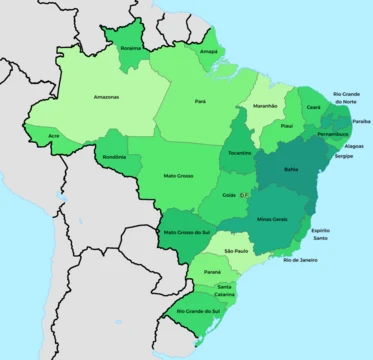
Alagoas is a state in Brazil’s Northeast Region, one of the country’s 27 federative units. It is the second smallest state by area—only Sergipe is smaller—and ranks 16th in population. Its capital is Maceió. The state borders Pernambuco to the north, Sergipe to the south, Bahia to the southwest, and the Atlantic Ocean to the east. It has 102 municipalities, with the largest cities being Maceió, Arapiraca, Palmeira dos Índios, Rio Largo, Penedo, União dos Palmares, São Miguel dos Campos, Santana do Ipanema, Delmiro Gouveia, Coruripe, and Campo Alegre. Alagoas holds 1.6% of Brazil’s population and generates 0.8% of its GDP. It is a major national producer of sugarcane, coconuts, and natural gas, and it has ongoing oil exploration, mostly from onshore deposits.
Originally, Alagoas was the southern part of the Captaincy of Pernambuco. It became an independent captaincy in 1817. Settlement began slowly in the early 1500s, driven by sugarcane farming that pushed southward from Pernambuco. The towns of Porto Calvo, Alagoas (now Marechal Deodoro), and Penedo emerged as early centers of colonization, economy, and society. The Dutch invaded Pernambuco and extended their campaign into Alagoas in 1631; they were expelled in 1645 after heavy fighting in Porto Calvo, leaving the economy ruined. During the Dutch occupation, many enslaved Africans escaped, creating a severe labor shortage on sugar plantations. These Africans formed villages called quilombos, the most important being Palmares, which was not fully destroyed until the late 1600s.
During the Brazilian Empire, the separatist and republican Confederation of the Equator gained support from notable Alagoans. In the 1840s, the state’s politics were dominated by a conflict between the *lisos* (conservatives) and the *cabeludos* (liberals). In the early 1900s, the hinterland saw a pioneering venture by Delmiro Gouveia, an entrepreneur from Pernambuco who built the Estrela thread factory, producing 200 spools daily. Gouveia was killed in October 1917 under unclear circumstances, reportedly after being pressured to sell his factory to foreign competitors. After his death, his machines were destroyed and thrown into Paulo Afonso Falls.
Alagoas is nicknamed the Land of the Marshals because it is the birthplace of Deodoro da Fonseca and Floriano Peixoto, Brazil’s first two presidents. Other notable Alagoans include anthropologist Arthur Ramos, maestro Hekel Tavares, philologist Aurélio Buarque de Holanda, musicians Djavan and Hermeto Pascoal, poet Jorge de Lima, jurists Pontes de Miranda and Marcos Bernardes de Mello, and writers Lêdo Ivo and Graciliano Ramos.
The state’s name comes from the Latin word for “reservoir” or “lake,” which evolved into Portuguese *alagoa*. The term appears in 16th-century references to the lagoons of Manguaba and Mundaú, near which settlements were founded. The name “Alagoas” came to include all the lagoons in the area. The suffix *-as* is common in Brazilian place names.
Geographically, the coast features fringing reefs and many beaches. Behind the beaches, steep scarps give way to green coastal hills with enough rainfall for agriculture and remnants of the Atlantic Forest, now mostly limited to steep slopes. This area has long been dominated by sugarcane. Further inland lies the Sertão, a high, dry region covered in thorny scrub called caatinga, home to cowboys who wear thick leather protection against the sharp vegetation.
- Capital
- Maceió
- Area rank
- 2nd smallest in Brazil (larger only than Sergipe)
- Population rank
- 16th in Brazil
- GDP share
- 0.8% of Brazilian GDP
- Major products
- Sugarcane, coconuts, natural gas, oil
- Notable natives
- Deodoro da Fonseca, Floriano Peixoto, Graciliano Ramos, Djavan
Lore & Background
Alagoas is the second smallest of Brazil’s 27 federative units by area, ranking 16th in population, and holds 1.6% of the national population while contributing 0.8% of the Brazilian GDP. Its territory lies in the eastern part of the Northeast Region, bordered by Pernambuco to the north, Sergipe to the south, Bahia to the southwest, and the Atlantic Ocean to the east. The capital is Maceió, and the state comprises 102 municipalities, with the most populous being Maceió, Arapiraca, Palmeira dos Índios, Rio Largo, Penedo, União dos Palmares, São Miguel dos Campos, Santana do Ipanema, Delmiro Gouveia, Coruripe, and Campo Alegre. The state’s name derives from the lagoons along its coast near Maceió. The coastline features fringing reefs and numerous fine beaches; behind them, steep scarps give way to green coastal hills with sufficient rainfall for agriculture, where remnants of the Atlantic Forest survive mainly on steep slopes and valley bottoms. This coastal zone has long been dominated by sugarcane cultivation. Farther inland lies the Sertão, a high, dry region covered by the thorn-filled, often toxic scrub called caatinga, home to cowboys who wear thick leather clothing for protection. Alagoas is a major national producer of sugarcane, coconuts, and natural gas, with ongoing oil exploration focused on onshore deposits. Nicknamed the “Land of the Marshals,” it is the birthplace of Deodoro da Fonseca and Floriano Peixoto, Brazil’s first two presidents.
Reader's Guide
Alagoas holds significance as a historical center of sugarcane production and as the birthplace of Brazil's first two presidents, Deodoro da Fonseca and Floriano Peixoto, earning it the nickname 'Land of the Marshals.' It is one of Brazil's largest producers of sugarcane, coconuts, and natural gas, with ongoing onshore oil exploration. The state's cultural legacy includes notable figures such as anthropologist Arthur Ramos, philologist Aurélio Buarque de Holanda, musicians Djavan and Hermeto Pascoal, and writer Graciliano Ramos. Its name derives from the lagoons along its coast, and its geography ranges from coastal hills and beaches to the dry Sertão region.
Did You Know?
- Alagoas is the second smallest Brazilian state in area, larger only than Sergipe.
- The state's name originates from the lagoons along its coast near Maceió.
- Deodoro da Fonseca and Floriano Peixoto, the first two presidents of Brazil, were born in Alagoas.
Coastal Lagoons and the Sertão
The name Alagoas traces back to the Portuguese word for lagoon, a term that evolved from the Latin word for lake or reservoir. Along the eastern shoreline near Maceió, a series of coastal lagoons—Manguaba, Mundaú, and others—gave the territory its identity as early as the sixteenth century. The coast itself is lined with fringing coral reefs and stretches of fine sand, and just behind the beaches, separated by steep scarps sometimes only a few hundred meters wide, rise green hills that receive enough rainfall to support agriculture and shelter the last fragments of the once-widespread Atlantic Forest, now confined to steep summits and valley floors. Pushing further inland, the landscape transforms into the Sertão, a high, arid plateau dominated by the caatinga—a scrubland of thorn-laced and sometimes toxic vegetation. This harsh interior has long been celebrated in regional legend and song, and its inhabitants are famously depicted wearing thick leather from head to toe to protect themselves from the sharp, unforgiving plants that carpet the ground.
Colonial Turmoil and the Quilombo of Palmares
During its colonial era, the region endured repeated external threats. One of the most consequential legacies of that invasion was the mass flight of enslaved Africans from the sugarcane plantations. These escapees organized themselves into fortified villages known as quilombos, and the most prominent of these, Palmares, resisted colonial authority until its destruction at the close of the seventeenth century. The labor shortage created by these exoduses profoundly shaped the plantation economy for generations.
Sugarcane, Energy, and the Gouveia Tragedy
Alagoas punches well above its modest size in the national economy. Although it holds only 1.6 percent of Brazil's population and contributes roughly 0.8 percent of the country's GDP, it ranks among the nation's leading producers of sugarcane, coconuts, and natural gas, with ongoing exploration of onshore oil deposits. The sugar industry has been the backbone of the coastal economy since the early days of colonization, when the need for new cultivation land pushed settlement southward from Pernambuco and gave rise to the first nuclei of Porto Calvo and Penedo. In the early twentieth century, the interior witnessed a bold industrial experiment: Delmiro Gouveia, a Pernambuco-born entrepreneur, established the Estrela thread factory in the town that now bears his name, producing two hundred spools of thread each day. After his death, his machinery was reportedly destroyed and cast into the Paulo Afonso Falls, a symbolic erasure of his achievement.
The Land of Marshals and a Gallery of Names
Alagoas is affectionately known as the Land of Marshals, a title earned by producing both Deodoro da Fonseca and Floriano Peixoto, the first two presidents of the Brazilian Republic. The state's political culture has been intensely contested for generations: during the imperial period, Alagoan figures lent support to the separatist Confederation of the Equator, and throughout the 1840s local politics was defined by the bitter rivalry between the 'lisos' (conservatives) and the 'cabeludos' (liberals). Beyond politics, the state has generated an extraordinary constellation of cultural and intellectual figures. The list includes the anthropologist Arthur Ramos, the composer Hekel Tavares, the philologist Aurélio Buarque de Holanda, the musicians Djavan and Hermeto Pascoal, the poet Jorge de Lima, the jurists Pontes de Miranda and Marcos Bernardes de Mello, and the writers Lêdo Ivo and Graciliano Ramos. For a state that is the second smallest in Brazil by area—larger only than neighboring Sergipe—this density of national influence is remarkable and speaks to a cultural vitality that far exceeds its geographic footprint.
Frequently Asked Questions
Who is Alagoas?
Alagoas is a federative unit in Brazil's eastern Northeast Region, with Maceió as its capital. It is one of the country's 27 states and carries the nickname 'Land of the Marshals' because of its deep political heritage.
What are Alagoas's powers/role?
Economically, Alagoas contributes roughly 0.8% of Brazil's GDP by producing sugarcane, coconuts, natural gas, and oil. It functions as a compact but vital agricultural and energy hub within the Northeast.
How does Alagoas's story end?
As a permanent federative unit, Alagoas has no narrative finale — it continues to operate as an active state home to over three million residents. Its legacy of political influence and resource production remains an ongoing chapter rather than a concluded one.
Why is Alagoas important?
Alagoas is the birthplace of both Deodoro da Fonseca and Floriano Peixoto, Brazil's first two presidents, which earned it the title 'Land of the Marshals.' This makes the state a foundational cradle of the nation's republican history.
What makes Alagoas unique among Brazilian states?
It is the second-smallest state by area, larger only than Sergipe, yet still ranks 16th in population. That compact footprint paired with its outsized role in early Brazilian politics sets it apart from its bigger neighbors.
More in Brazilian States 1-24
Spotted an error? Know more?
This is a living reference — every entry is fact-audited, and reader corrections feed straight into our audit queue. Suggest an edit · See this site's audit record