Bahia
Brazilian state, former colonial capital, center of sugar and slavery.
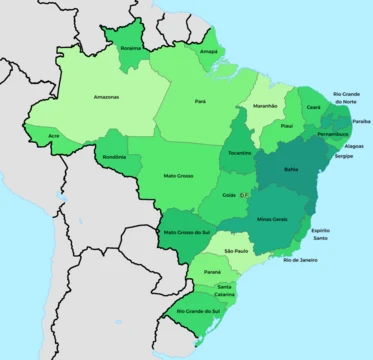
Bahia is one of the 26 states of Brazil, located in the Northeast Region. It ranks as the fourth-most populous state and the fifth-largest by area. As the primary center of the early Brazilian slave trade, Bahia holds the strongest and most distinctive African influence in Brazil, evident in its culture and customs. This heritage includes the Yoruba-derived religious system of Candomblé, the martial art of capoeira, and musical styles such as samba-de-roda, samba-reggae, afoxé, and axé. The state’s cuisine, particularly in the capital Salvador, also has deep links to West Africa. In the interior, a traditional culture of vaqueiros (cowboys) has persisted among agricultural communities since the 1550s, when these farmers were key to Brazil’s expansion away from the coast. Bahia is the birthplace of many renowned artists, writers, and musicians. Notable figures include the Tropicália movement’s Caetano Veloso and Gilberto Gil, bossa nova pioneer João Gilberto, and axé music stars Daniela Mercury and Ivete Sangalo. In literature, the state produced the 19th-century abolitionist poet Castro Alves, whose poem *Navio negreiro* is a central anti-slavery text, and the 20th-century novelist Jorge Amado, author of internationally adapted works like *Gabriela, Clove and Cinnamon*. Other significant Bahian writers include Gregório de Matos and Father António Vieira, who helped expand the Portuguese language in Brazil.
- Capital
- Salvador
- Area
- 5th-largest among Brazilian states
- GDP share
- 4.2% of Brazil's GDP
Lore & Background
Bahia is a state in Brazil’s Northeast region, with Salvador as its capital and largest city. Its population was approximately 14.87 million in 2025, ranking fourth among Brazilian states, and it covers an area of 565,733 square kilometers, the fifth-largest in the country. The state’s flag bears the motto “I rise through the hardship.” Bahia is considered the chief locus of the early Brazilian slave trade, giving it the greatest and most distinctive African imprint in Brazil in terms of culture and customs. This influence is evident in the Yoruba-derived religious system of Candomblé, the martial art capoeira, and musical styles such as samba-de-roda, samba-reggae, afoxé, and axé. The cuisine, especially in Salvador, has strong links to western Africa. In the interior, the traditional culture of vaqueiros (cowboys) persists among agricultural communities, a tradition dating to the 1550s when these farmers helped expand settlement away from the coast. Bahia is also the birthplace of many noted Brazilian artists, writers, and musicians, including figures from the Tropicália movement, bossa nova, samba, and axé music. Notable literary figures include the 19th-century abolitionist poet Castro Alves, who wrote the anti-slavery poem *Navio negreiro*, and 20th-century novelist Jorge Amado, whose works such as *Gabriela, Clove and Cinnamon* became internationally renowned films. The state contains historic towns from the sugar era, such as Cachoeira.
Reader's Guide
Bahia's significance lies in its historical role as the first capital of Portuguese America and a key hub of the Atlantic slave trade and sugar economy. Its politics have been closely intertwined with national politics, producing figures such as Ruy Barbosa and Antônio Carlos Magalhães, whose influence shaped state politics for decades. The state's geography includes the Bay of All Saints, the largest bay on the Brazilian coast, and the São Francisco River, vital for irrigation and hydroelectric power. Bahia's climate is tropical, with 68% of its territory in the semi-arid zone. Today, it is a predominantly working-class industrial and agricultural state, home to 7% of Brazil's population and producing 4.2% of its GDP.
Did You Know?
- Bahia's capital Salvador was originally named 'Cidade do São Salvador da Bahia de Todos os Santos'.
- The Sobradinho Dam on the São Francisco River created one of the largest reservoirs in the world.
More in Brazilian States 1-24
Spotted an error? Know more?
This is a living reference — every entry is fact-audited, and reader corrections feed straight into our audit queue. Suggest an edit · See this site's audit record