Rio de Janeiro (state)
State of Rio de Janeiro, Brazil's second-largest economy.
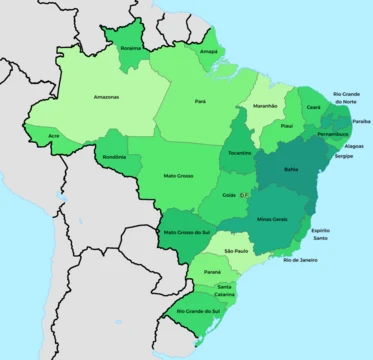
Rio de Janeiro is one of the 27 federative units of Brazil, located in the Southeast region as classified by IBGE. It shares borders with the other states of this macroregion: Minas Gerais to the north and northwest, Espírito Santo to the northeast, and São Paulo to the southwest, while the South Atlantic Ocean bounds it to the east and south. Though the smallest state by area in the Southeast and one of the smallest in Brazil, it is the third most populous, with over 16 million residents according to the 2022 Census, making it the most densely populated state in the country. It also possesses the third longest coastline in Brazil, after Bahia and Maranhão. The state has the second largest economy in Brazil, responsible for 9.2% of the national GDP while containing 8.2% of the population. Its capital is the city of Rio de Janeiro, which served as the capital of the Portuguese Colony of Brazil from 1763, of the United Kingdom of Portugal, Brazil and the Algarves from 1815, and of independent Brazil from 1822 until 1960. The state is divided into 92 municipalities. On the Brazilian flag, Rio de Janeiro is represented by the beta star Mimosa in the Southern Cross. The name originates from a January 1502 encounter by Portuguese explorers Gaspar de Lemos and Gonçalo Coelho at Guanabara Bay, initially called "Ria de Janeiro" before confusion with the word for river fixed the name. The demonym for the state is fluminense, from Latin for river, sanctioned in 1783 for the Royal Captaincy; carioca became the city's demonym after the 1975 merger of Guanabara State into Rio de Janeiro State. European presence began in 1502, with French occupation between 1555 and 1567, countered by Estácio de Sá founding the city in 1565. The 18th-century gold trade via the port spurred growth, and the 1808 arrival of the Portuguese royal family brought urban reforms, including the Bank of Brazil, the Royal Press, and the Botanical Garden. In 1834, the city became a neutral capital while Niterói served as provincial headquarters. After Brasília became the federal capital in 1960, Rio de Janeiro city became Guanabara State, merging with Rio de Janeiro State in 1975 to restore the city as a municipality.
- capital
- Rio de Janeiro
- largest_cities
- Rio de Janeiro, São Gonçalo, Duque de Caxias, Nova Iguaçu, Niterói, Campos dos Goytacazes
- economy_rank
- second largest in Brazil
- GDP_share
- 9.2% of Brazilian GDP
- demonym
- fluminense
Lore & Background
The state of Rio de Janeiro is one of Brazil’s 27 federative units, located in the Southeast region as defined by IBGE. It is the smallest state in that macroregion by area and among the smallest in the country, yet it ranks as the third most populous Brazilian state, with over 16 million residents according to the 2022 Census, making it the most densely populated state. Its coastline is the third longest in Brazil, after Bahia and Maranhão. The state borders Minas Gerais to the north and northwest, Espírito Santo to the northeast, and São Paulo to the southwest, while the South Atlantic Ocean lies to the east and south. Its capital is the city of Rio de Janeiro, which served as the capital of the Portuguese colony from 1763 to 1815, of the United Kingdom of Portugal, Brazil and the Algarves from 1815 to 1822, and of independent Brazil until 1960. The state is divided into 92 municipalities, with major cities including Rio de Janeiro, São Gonçalo, Duque de Caxias, Nova Iguaçu, Niterói, Campos dos Goytacazes, and Petrópolis. The economy is the second largest in Brazil, responsible for 9.2% of national GDP despite having 8.2% of the population. On the Brazilian flag, the state is represented by the beta star Mimosa in the Southern Cross constellation. The official demonym for the state is fluminense, derived from Latin for “river,” while carioca is the demonym for the city of Rio de Janeiro, a distinction formalized after the 1975 merger of Guanabara State into Rio de Janeiro State.
Reader's Guide
The state of Rio de Janeiro, the third most populous in Brazil and the most densely populated, is located in the Southeast macroregion, bordering Minas Gerais, Espírito Santo, São Paulo, and the South Atlantic Ocean. Its territory, the smallest in the Southeast, includes 92 municipalities and the third longest coastline in the country. The capital, the city of Rio de Janeiro, served as the capital of the Portuguese colony from 1763, later of the United Kingdom of Portugal, Brazil and the Algarves, and finally of independent Brazil until 1960. The state’s economy is the second largest in Brazil, responsible for 9.2% of the national GDP despite having 8.2% of the population. Historically, the region’s development was spurred by cattle raising and sugar cane in the 17th century, and later by gold exports from Minas Gerais through its port. The arrival of the Portuguese royal family in 1808 prompted urban reforms, the creation of the Bank of Brazil, the Royal Press, and the Botanical Garden. The city of Rio de Janeiro became a neutral city in 1834, with Niterói serving as the state capital. After the federal capital moved to Brasília in 1960, the city became Guanabara State. In 1975, Guanabara merged with Rio de Janeiro state, restoring the city to a municipality. The demonym for the state is fluminense, while carioca refers to the city’s inhabitants. On the Brazilian flag, the state is represented by the beta star Mimosa in the Southern Cross.
Did You Know?
- Rio de Janeiro is the smallest state by area in the Southeast macroregion but the most densely populated in Brazil.
- The state's coastline is not among the three longest in Brazil.
- The state is responsible for 9.2% of the Brazilian GDP while having 8.2% of the population.
A Capital That Defied the Colonial Order
Rio de Janeiro occupies a singular position in world history. Under Prince Regent John of Braganza, Brazil was elevated to kingdom status within the United Kingdom of Portugal, Brazil, and the Algarves. This made Rio the capital of a pluricontinental monarchy — a first and, as the record shows, the only instance in modern history in which a colonizing nation officially shifted its capital to a city within one of its own colonies. The city retained that capital role through the Empire of Brazil until 1889 and continued as republican Brazil's seat of government until 1960, when Brasília was inaugurated. The sudden arrival of hundreds of nobles forced the eviction of local residents, yet the era also produced lasting institutions: the National Library of Brazil, the Botanical Garden, the Military Academy, and the Gazeta do Rio de Janeiro, the country's first printed newspaper.
Economic Engine and Research Hub
Rio de Janeiro punches well above its weight in Brazil's economic landscape. The city anchors the headquarters of two of Brazil's largest corporations — Petrobras in oil and Vale in mining — along with Grupo Globo, Latin America's biggest telemedia conglomerate. The city hosts numerous universities and research institutes that sustain this intellectual infrastructure. Despite a persistent public perception of high crime, the actual incidence of crime in Rio is lower than in most other Brazilian state capitals, a nuance that complicates the city's international reputation.
Stage for the World
Rio de Janeiro has repeatedly placed itself at the center of global spectacle. Beyond mega-events, Rio's cultural identity is woven into its physical landscape: the Sambódromo hosts Carnival parades, Christ the Redeemer atop Corcovado was named one of the New Seven Wonders of the World, and Sugarloaf Mountain offers sweeping views via cable car. The beaches of Copacabana, Ipanema, Leblon, and Barra da Tijuca, alongside the rhythms of samba and bossa nova, define the city's global image.
From French Forts to Portuguese Founding
The story of Rio de Janeiro begins with a name rooted in a calendar date. The region had long been home to Tupi, Puri, Botocudo, and Maxakalí peoples. The Portuguese, viewing this as a serious strategic threat, launched a years-long military campaign under Governor General Mem de Sá and later his nephew Estácio de Sá. For decades afterward, the settlement faced repeated incursions by French pirates and buccaneers, underscoring how contested this strategic harbor truly was.
Frequently Asked Questions
How does Rio de Janeiro (state) rank economically in Brazil?
The state holds the second-largest economy in the country, accounting for roughly 9.2% of Brazil's total GDP. This positions it as a major industrial and financial hub just behind São Paulo.
What are the biggest cities in Rio de Janeiro (state) besides the capital?
The state's other major urban centers include São Gonçalo, Duque de Caxias, Nova Iguaçu, Niterói, and Campos dos Goytacazes. Together they anchor the metropolitan and regional economies that drive the state's output.
More in Brazilian States 1-24
Spotted an error? Know more?
This is a living reference — every entry is fact-audited, and reader corrections feed straight into our audit queue. Suggest an edit · See this site's audit record