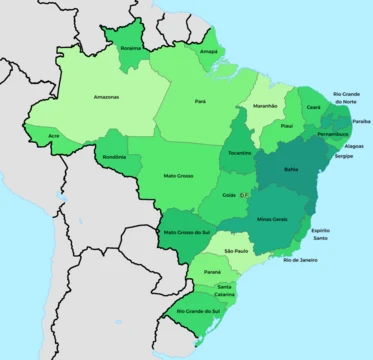
Southeast Region, Brazil
Richest and most populous region of Brazil.

via Wikipedia: Southeast Region, Brazil · see source
The Southeast Region of Brazil (Portuguese: Região Sudeste do Brasil, pronounced [ʁeʒiˈɐ̃w suˈdɛstʃi du bɾaˈziw]) is composed of the states of Espírito Santo, Minas Gerais, Rio de Janeiro, and São Paulo. It is the richest region of the country, responsible for approximately 53% of the Brazilian GDP (2022), as São Paulo, Rio de Janeiro, and Minas Gerais are the three richest states of Brazil, the top three Brazilian states in terms of GDP. The Southeast of Brazil also has the highest GDP per capita among all Brazilian regions. The Southeast region accounts for about 44% of Brazil's total population, leading the country in population, urban population, population density, vehicles, industries, universities, airports, ports, highways, hospitals, schools, houses and many other areas.
- Composition
- Espírito Santo, Minas Gerais, Rio de Janeiro, São Paulo
- GDP share
- Approximately 53% of Brazilian GDP (2022)
- Population share
- About 44% of Brazil's total population
- Richest states
- São Paulo, Rio de Janeiro, and Minas Gerais are the three richest states in Braz
- Highest GDP per capita
- Among all Brazilian regions
Verified Timeline
Lore & Background
The Southeast Region leads Brazil in population, urban population, population density, vehicles, industries, universities, airports, ports, highways, hospitals, schools, and houses. Its geography includes the Ribeira Valley in São Paulo, which contains the largest concentration of caves in Brazil, with 454 caves registered by the Brazilian Society of Speleology (SBE) in the State of São Paulo, all at the Ribeira Valley. The 280 caves located at PETAR represent the biggest concentration of caves in Brazil. The region also holds the Pico da Bandeira, the third highest mountain in Brazil at 2890 m, on the border between Minas Gerais and Espírito Santo. In mineral production, in 2017, Minas Gerais was the country's largest producer of iron (277 million tons worth R $37.2 billion), gold (29.3 tons for a value of R $3.6 billion), zinc (400 thousand tons for a value of R $351 million) and niobium (in the form of hydrochloride) (131 thousand tons for a value of R $254 million). The state has the largest production of various gemstones in the country. In aquamarine, Minas Gerais produces the most valuable stones in the world. Imperial Topaz, a valued variety of topaz, is only found in Ouro Preto.
Reader's Guide
The Southeast Region's significance lies in its dominant economic and demographic role within Brazil. It produces the vast majority of the country's coffee (85% of the country's production, which is the world's largest producer), sugarcane (65% of the country's production, which is the world's largest producer), and orange (85% of the country's production, which is the world's largest producer), and is a leading producer of many other crops including lemon (80% of the country's production, which is the fifth largest producer in the world), peanut (90% of the country's production, which is the 14th largest producer in the world), banana (35% of the country's production, which is the seventh largest producer in the world), and sorghum (30% of national production, the country being the seventh largest producer). In mining, Minas Gerais had 47.19% of the value of the production of minerals marketed in Brazil (first place), with R $41.7 billion. The region is also a major center for livestock, being the second national producer of milk, with 34.2%, and a leader in poultry farming and egg production. The Southeast region was responsible for 43.8% of the total produced of chicken eggs in 2018. Its cultural and natural heritage includes the Ribeira Valley, a Natural Heritage of Humanity, granted heritage as a Biosphere Reserve by UNESCO, and the diverse ecosystems of the Mata Atlântica biome.
Did You Know?
- The Southeast Region has the highest GDP per capita among all Brazilian regions.
- The Ribeira Valley in São Paulo contains 454 caves registered by the Brazilian Society of Speleology, with 280 located at PETAR — the biggest concentration of caves in Brazil.
- Pico da Bandeira, the third highest mountain in Brazil at 2890 m, stands on the border between Minas Gerais and Espírito Santo.
- Minas Gerais is the country's largest producer of iron, gold, zinc, and niobium, and produces the most valuable aquamarine stones in the world.
- Imperial Topaz, a valued variety of topaz, is only found in Ouro Preto, in the state of Minas Gerais.
More in Brazilian States 1-24
Related in Brazilian States
Links follow this subject's own source article.
Elsewhere in the Brazilian States universe
Spotted an error? Know more?
This is a living reference — every entry is fact-audited, and reader corrections feed straight into our audit queue. Suggest an edit · See this site's audit record