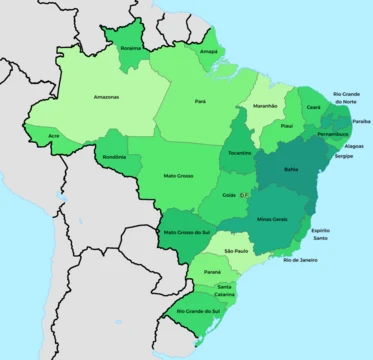
South Region, Brazil
Smallest Brazilian region, highest HDI, strong European heritage.

via Wikipedia: South Region, Brazil · see source
The South Region of Brazil (Região Sul do Brasil) is one of the five regions of Brazil, comprising the states of Paraná, Rio Grande do Sul, and Santa Catarina. It is the smallest region by area, covering 576,409.6 square kilometers, and is known for its high standard of living, strong European immigrant heritage, and agricultural productivity. It borders Uruguay, Argentina, and Paraguay, as well as the Centre-West and Southeast regions, and the Atlantic Ocean. The region is considered the safest in Brazil to visit, having a lower crime rate than other regions in the country.
- area
- 576,409.6 sq km
- human_development_index
- 0.859 (2007)
- literacy_rate
- 98.3%
- per_capita_income
- $13,396
- urbanization
- 82%
Verified Timeline
Lore & Background
European colonization began with Portuguese and Spanish Jesuit missionaries, who lived among the Natives and converted them to Catholicism, followed by Bandeirantes from São Paulo. To secure Portuguese control, the King of Portugal encouraged Azorean immigration; between 1748 and 1756, six thousand Azoreans arrived, composing over half the population of Rio Grande do Sul and Santa Catarina by the late 18th century. German immigrants began arriving after Brazil's independence in 1822 from Portugal, recruited as small farmers; by 1904, an estimated 50,000 Germans had settled in Rio Grande do Sul. In Santa Catarina, private groups like the Hamburg Colonization Society created rural communities that grew into cities such as Blumenau and Joinville, the largest city in Santa Catarina. Italian immigrants, mostly peasants from the Veneto in Northern Italy, started arriving in 1875; by 1914, 100,000 Italians had settled in Rio Grande do Sul, with many others in Santa Catarina and Paraná. In 1898, there were 300,000 people of Italian origin in Rio Grande do Sul, 50,000 in Santa Catarina, and 30,000 in Paraná. Today, Italian South Brazilian descendants number 9.7 million and comprise 35.9% of Southern Brazil's population.
Reader's Guide
The South Region is a major economic and cultural pole, bordering Uruguay, Argentina, Paraguay, and the Atlantic Ocean. It is considered the safest region in Brazil for visitors, with a lower crime rate than other regions. Its economy is heavily agricultural: the region produces nearly all of Brazil's tobacco, grapes, apples, wheat, oats, and yerba mate, as well as 80% of its rice, 35% of its soy and maize, and 25% of its cassava. In livestock, the South holds 12% of Brazil's cattle (27 million head), is second in sheep farming with 4.2 million head, and leads in milk production with 35.7% of the national total. The Ragamuffin War (1835–1845) was a Republican uprising in Rio Grande do Sul and Santa Catarina, led by generals Bento Gonçalves da Silva and Antônio de Souza Netto with support from Giuseppe Garibaldi, who joined in 1839; the war ended with peace negotiations in 1845. The region is highly urbanized (82%) and has a relatively high standard of living, with the highest Human Development Index of Brazil (0.859 in 2007), the second highest per capita income ($13,396), and a 98.3% literacy rate.
Did You Know?
- The South Region is the smallest of Brazil's five regions, covering 576,409.6 square kilometers—smaller than the state of Minas Gerais or metropolitan France.
- Between 1748 and 1756, six thousand Azoreans arrived, composing over half the population of Rio Grande do Sul and Santa Catarina by the late 18th century.
- The Ragamuffin War (1835–1845) was a Republican uprising in Rio Grande do Sul and Santa Catarina, supported by the Italian warrior Giuseppe Garibaldi.
- Italian South Brazilian descendants number 9.7 million and make up 35.9% of the region's population.
- The South Region produces 99% of Brazil's wool and leads the country in milk production, with 35.7% of the national total.
More in Brazilian States 1-24
Related in Brazilian States
Links follow this subject's own source article.
Elsewhere in the Brazilian States universe
Spotted an error? Know more?
This is a living reference — every entry is fact-audited, and reader corrections feed straight into our audit queue. Suggest an edit · See this site's audit record