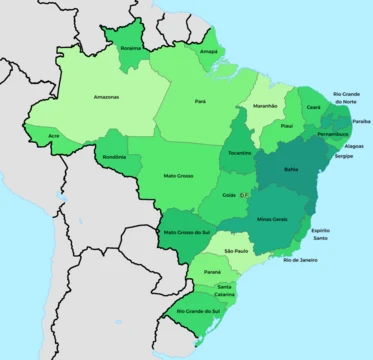
North Region, Brazil
Largest Brazilian region, home to the Amazon Rainforest.

via Wikipedia: North Region, Brazil · see source
The North Region of Brazil is the largest region of the country, accounting for 45.27% of the national territory. It has the second-lowest population of any region in Brazil and the lowest population density, with only 4.5 inhabitants per km². The region is home to the Amazon Rainforest, which represents over half of the planet's remaining rainforests and is the most species-rich tract of tropical rainforest in the world. The region comprises the states of Acre, Amapá, Amazonas, Pará, Rondônia, Roraima, and Tocantins. Most of the population is centered in urban areas.
- area_percentage_of_Brazil
- 45.27%
- population_density
- 4.5 inhabitants per km²
- states
- Acre, Amapá, Amazonas, Pará, Rondônia, Roraima, Tocantins
- climate
- Equatorial, with averages from 24°C to 26°C
- major_cities
- Belém, Manaus
- key_economic_activities
- Vegetal extraction (latex, açaí, woods, Brazil nuts), mineral extraction (gold,
Lore & Background
The first inhabitants of the North Region were Native Brazilians, who lived in diverse tribes and villages from the pre-Columbian period until the arrival of Europeans. Spanish explorers, including Francisco de Orellana, organized expeditions along the Amazon River. After long journeys alongside Orellana, Gonzalo Fernández de Oviedo y Valdés wrote a letter to Cardinal Pedro Bembo in Venice, extolling the region's fauna and flora. In the 17th century, the Portuguese arrived, building military strongholds to defend the region against invasion, and in 1616 founded Belém do Pará. Catholic missionaries came to catechize the natives, gathering them into villages called missions, which later gave rise to cities such as Borba and Óbidos. During the 1960s, 1970s, and 1980s, military governments implemented a major plan to integrate the region, including construction of highways like the BR-010, installation of industries, and creation of the Free Economic Zone of Manaus.
Reader's Guide
The North Region of Brazil is significant for its immense size and ecological importance. It contains the Amazon Rainforest, which holds unparalleled biodiversity: over one-third of all species in the world live there, including at least 40,000 plant species, 3,000 fish, 1,294 birds, and 427 mammals. One square kilometre may contain over 75,000 types of trees and 150,000 species of higher plants. The region's economy relies on vegetal extraction (latex, açaí, woods, Brazil nuts) and mineral extraction (gold, precious stones, cassiterite, tin), as well as mining of iron at Carajás Mountain Range and manganese at Navio Mountain Range, plus the Free Economic Zone of Manaus. Culturally, it features distinctive folklore such as the Parintins Folklore Festival, Círio de Nazaré in Belém, and typical dances like Marujada and Carimbó. The gastronomy has Indigenous, African, and Portuguese roots, with dishes like duck in tucupi sauce, maniçoba, and tacacá, and fruits such as açaí, pupunha, and cupuaçu. The region's history includes early indigenous habitation, Spanish and Portuguese exploration, missionary settlement, rubber extraction from 1840 to 1910, and modern development projects. Its low population density and high biodiversity make it a critical area for global environmental conservation.
Did You Know?
- The North Region accounts for 45.27% of Brazil's national territory and is slightly larger than India.
- One square kilometre of Amazon rainforest can contain about 90,790 tonnes of living plants.
- The region has the lowest population density in Brazil, with only 4.5 inhabitants per km².
- The 'friagem' phenomenon, caused by La Niña, can bring cold air masses from the South Atlantic to parts of Amazonas, Rondônia, and Acre.
- The Parintins Folklore Festival and Círio de Nazaré in Belém are major cultural attractions in the region.
More in Brazilian States 1-24
Related in Brazilian States
Links follow this subject's own source article.
Elsewhere in the Brazilian States universe
Spotted an error? Know more?
This is a living reference — every entry is fact-audited, and reader corrections feed straight into our audit queue. Suggest an edit · See this site's audit record